America, the Atlantic, and Global Consumer Demand, 1500-1800
The Atlantic migration of Europeans and Africans to America and the commercial activities associated with it created an economy that for the first time in history could be called global. For many years, historians have relied upon the word mercantilism to capture this international world. Over the last decade, as research has focused more intently on ties between early modern consumers, producers, and distributors in America, Europe, and Africa, the concept of an Atlantic world economic community has eclipsed the mercantilism paradigm. More recently, scholarly voices have cautioned against portraying the commerce of the Atlantic as a separate economic world unto itself and ignoring the true globalism of trade in the period. In discussing the evolving conceptualization of the early modern economy, it is important not only to recognize the commercial growth that occurred during the period, but also to take into account the demographic and environmental changes that were consequences of that growth.
The mercantilist explanation for what kept the early modern economy running is quite straightforward. The kingdoms of Spain, Portugal, Great Britain, and France as well as the Dutch Republic each sought to accumulate wealth through advantageous overseas trading arrangements and colonies, while thwarting the ambitions of their rivals to do the same. America played the role of colony. When I use the term America here, I do not just mean the thirteen colonies that bolted from the British Empire in 1776, but rather the entire Western hemisphere. For nearly all of the period under consideration, the area that became the U.S. had no separate identity. The thirteen colonies were neither the only colonies nor the only British colonies, and in the view of the rest of the world, none of the thirteen were considered as the most important in the New World. That honor would probably go to the sugar islands of the West Indies or, depending on the century, either the viceroyalty of Peru or New Spain, the main sites of silver mines. The scrappy, slave-trading, rum-running, smuggling-prone merchant communities that sprang up in towns like Boston, Newport, New York, Philadelphia, and Charleston might command center stage from the perspective of the national history of the U.S., but they contained just a small proportion of the cast of thousands who developed new markets in America.
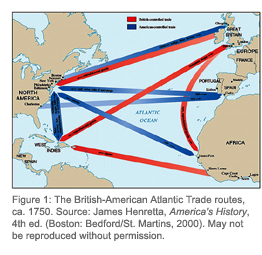
Though the mercantilist paradigm was a global one, the most common visualization of it in U.S. history textbooks featured a map of Atlantic commerce. This map [for an example see Figure 1] illustrated the "Triangular Trade" whereby eastern American colonies furnished raw materials, western Africa provided the labor force to produce the raw materials, and the imperial center, often referred to as the Mother Country, shipped manufactured goods to both. Historians pointed to inequities in this system as an important cause of the American Revolution.
Today, this schema has not so much been repudiated as re-interpreted. The most salient economic characteristic of the period remains the growth in overseas commerce, but the term mercantilism is now used infrequently and the marketplace desires of individuals—especially on the consumption side—receive much greater credit for effecting change. Students are encouraged to think less about European empires struggling for control of the major sea lanes and colonial bases to achieve favorable trading balances and more about the Atlantic as a meaningful economic entity where coastal inhabitants from all continents exchanged people and goods without always honoring imperial boundaries (1).
To Atlantic scholars, it is not just a European or European transplant story. Transatlantic migrants were three times more likely to be from Africa than Europe during the period (2), and as a result historians now have to take account of the strategies of African kingdoms and institutions in the making of the slave trade (3). Indian nations are not only relevant as providers of furs and skins and consumers of manufactures and alcohol but as the introducers of new agricultural commodities and, in some regions of America, a prime source of labor and cultural identity. The persistence with which colonists fixed their gaze across the Atlantic rather than across the American continent may have less to do with their attachment to Europe and more to do with the ability of Indian nations to contain colonial settlements to coastal areas, up until the latter eighteenth century.
The availability of land and natural resources in America enabled the collection or production of a wide variety of commodities—furs, lumber, cod, and wheat, for example. It was, however, the demand for two categories of goods that stands out as being most responsible for the continuing flow of capital, labor, and governmental military services across the Atlantic: groceries and silver.
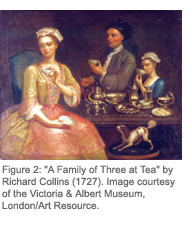
Contemporaries called the tropical dietary items that acted as energizers and appetite appeasers for the population on either side of the Atlantic and in Asia groceries. They included tobacco, sugar, sugar byproducts such as molasses and rum, and caffeine drinks, namely tea, coffee, and cocoa. America became the prime site for growing all of these crops except for tea and the enslaved migrants from Africa became the prime cultivators. Tobacco and the beans to make cocoa were indigenous to America while others—coffee and sugar—were transferred over to take advantage of the low cost of land and the bound labor force. Because many of these plantation commodities were thought of as luxuries—that is, not essential for human survival—their central role in the expansion of the world economy has been often overlooked (4). That is a misconception, however. By the late seventeenth century, the Dutch and the English dominated the carrying trade over the Atlantic. 74 percent of the value of imports coming into Amsterdam and more than 85 percent coming into London from colonies in America consisted of tobacco and sugar products (5). Portraits, aristocratic and more middling class, as in the household shown here [see Figure 2], often displayed the paraphernalia—tea service, porcelain tea cups, sugar bowls, clay pipes, snuff boxes—associated with the consumption of these tropical groceries. By the eighteenth century, the laboring classes also used these groceries on a regular basis (6).
Initially, western European governments gave little encouragement to the consumption of such commodities. In fact royal authorities often disparaged their production and use, considering them either harmful or trivial. Instead, support for the commodities came from transatlantic merchant-planter alliances along with consumers living in maritime communities and urban centers. Once the revenues from the import duties began pouring into the treasury, however, the royals changed their minds. These seemingly frivolous raw materials altered the dietary habits of the Atlantic community and ultimately the world. They were responsible for the spread of the plantation complex (7), a system of production that would become extremely controversial in the nineteenth-century U.S. Taking a specific commodity such as tobacco and tracing the diffusion of consumption and the transformation in production and distribution to meet demand has emerged as an important way to study Atlantic history in the early modern period.
Even the way historians portray the relationship between the commercial system and the American Revolution has been transformed by the Atlantic world approach. Americans reacted to the taxation of sugar products, tea, and British manufactured goods, it has been argued, as consumers. Colonists from disparate provinces with divergent interests could all relate to problems connected to the consumption of the empire's goods. Their mass consumption led to their mass mobilization: resisting the Sugar, Stamp, and Townshend Acts, boycotting tea, pledging nonimportation, and ultimately declaring independence (8). Rather than viewing the American Revolution as the point at which the colonies threw off mercantilism and embraced economic liberalism (9), students are now encouraged to regard the market principles of demand and supply as representing the colonial status quo. The colonists, in this telling of the story, mobilized in order to halt any heavy handed imperial state meddling that would turn back the clock.
The Atlantic world concept has much to recommend it as a way to understand the global economy in which the U.S. came to be a dominant player. The Atlantic as the supplier of population for America cannot be denied. Migration from other parts of the globe during these years amounted to little more than a trickle. The dramatic transformation of Atlantic commerce is also obvious. For thousands of years prior to the mid-fifteenth century, existing evidence suggests that nothing ventured far out into the Atlantic aside from a few Viking expeditions and occasional fishing vessels, while in the next three hundred years global commerce came to be directed and conducted from nations and cities bordering that ocean. And so it remained until the later twentieth century when the emergence of the Pacific Rim, the European Union, and NAFTA suggest that a realignment is now taking place (10).
Where the Atlantic world paradigm falls short, in the view of some scholars, is in its poor integration of Asia, home to two-thirds of the world's population, into the early modern network of trade. They argue that western Europe and even parts of the Americas and Africa had relationships with Asia that were as or more important than their relationships with one another (11). The choice then is whether we should think in terms of two separate worlds operating in this period, the Asian world and the demographically much smaller Atlantic world of which America was a part, or whether we should consider the east-west connection significant enough to argue for a fully integrated global economy.
Those arguing the latter position would point out that capturing the East Indian and Chinese market loomed much larger in the minds of Europeans than anything having to do with America or Africa and that America owed its "discovery" to that preoccupation. Columbus's and his sponsors' stated purpose was not the discovery of a New World but a northwest passage to the "Indies," by which they meant East Asia. Just as the first Portuguese attempts to sail around Africa had been sparked by the hope to establish trade with India, about the only reason for undertaking voyages to the Americas, until Cortes defeated the Aztecs in 1519, was to find East Asia. Even after Cortes's conquest, which led to an influx of sword wielding military adventurers seeking tribute, a northwest passage project proved much more attractive to merchant investors than any military expedition. The picture changed once again, however, with the discovery of rich silver mines in America. Silver is the other major product that most directly linked America with the global economy and, in terms of chronology, it came before the groceries associated with the plantation complex.
The old histories of mercantilism centered their story on the infusion of Spanish empire silver and gold, the rampant inflation in Europe it produced, and its role in the underdevelopment of Spain and its colonies. The new version of this story considers inflation less of a problem and concentrates on the enormity of Chinese demand for silver, which was needed both to expand its monetary system and to manufacture silver wares. Its willingness to offer advantageous terms of trade for those sought-after commodities created a global commercial network in which America and Africa supplied the bullion and foodstuffs to pay for Asian commodities distributed largely in European ships (12).
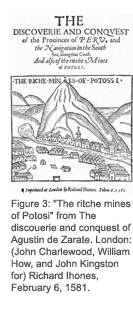
It was the mining of precious metals that kept European kings and commoners interested in the Americas during that awkward half century or so between the last conquistadors and the first big boom in sugar and tobacco cultivation that ushered in the American plantation complex. Not until the discovery of silver at Potosi in the Peruvian vice-royalty during the 1540s did the Spanish Crown, as distinct from private adventurers and religious orders, make a commitment to govern America directly. Forcing Indians to extract the valuable ore [see a contemporary's depiction of the Potosi community in Figure 3], every year the Spaniards shipped over 50 tons of silver abroad. They sent it across the Atlantic where their European creditors used it in the Chinese trade or they transported it across the Pacific to Manila, Spain's east Asian entrepôt. Why in the 1570s did Sir Francis Drake, the famous Elizabethan privateer, venture into the Pacific and circumnavigate the globe? Pure love of adventure? Or could the mines of Peru have had something to do with it? Without the lure of these Atlantic and Pacific fleets full of bullion most English, French, and Dutch exploration and colonization expeditions would never have materialized.

Western European nations granted monopolies to trading companies, the big businesses of the day, to compete for Asian commodities. Some were dietary products like Chinese tea and spices from what is now known as Indonesia, but others were manufactured goods such as Chinese porcelain and silk and Indian cotton cloth (13). All of these goods became wildly popular in Europe and America. In fact, in 1720 the British government forbade the importation of cotton cloth because it weakened demand for light woolens, their major industrial product. The Chinese refused to allow western European trading companies to establish permanent facilities in their port cities, so western Europeans, first the Portuguese and then a wider international community, built a commercial center at Macao on the west banks of the Pearl, the river which leads to the Chinese port of Canton. [Figure 4 indicates the size of the European enclave.] Not until later in the nineteenth century did Hong Kong, on the east side of the Pearl River, overtake Macao. Both cities remained under the control of western Europeans until the end of the twentieth century. Manila, the Spanish entrepôt, also spent most of its history as a colony. Originally, however, these outposts had been set up because it was the only way westerners could obtain Chinese products.
Consumer demand for East Indian commodities grew over the course of the eighteenth century. In an important departure from the past and one that foreshadowed nineteenth-century developments, Europeans learned how to mass produce "knock-offs" of east and south Asian cloth, furniture, and pottery. It was the manufacturing of Indian-like cotton fabric in Britain that launched the Industrial Revolution. After independence, as the American merchant community regrouped, those on the Atlantic seaboard began competing with their former partners for the lucrative China trade and manufacturing "knock-offs" of their own. Using Hawaii as an entrepôt, the U.S. also expanded Pacific commerce (14). By 1800 it was Britain's biggest competitor in the China trade and later in cotton cloth manufacturing (15).
The three different approaches to understanding the place of pre-1800 America in the international economy each have their strengths and weaknesses. The mercantilism paradigm, emphasizing as it does imperial rivalries, is global in scope but relies almost exclusively on the machinations of European royal governments to explain commercial expansion and colonization. The proponents of the Atlantic world view assert that the use of said ocean as a highway for migrants, capital, and commodities represented the period's biggest change in world trade patterns and that consumer demand of the societies bordering the ocean had much to do with that change. Assuming, however, that a self-contained commercial system existed within the boundaries of that ocean, critics contend, means leaving out more than two-thirds of the consumers of the earth, including those in China, India, and southeast Asia, producers of some of the world's most sought-after commodities. Better integration of such important elements as the silver trade to China, the boom in Indian cotton textiles, and the commercial history of the settlements and islands of the Pacific is a task currently underway, even if the exact importance of each of these elements in the overall picture has yet to be ascertained.
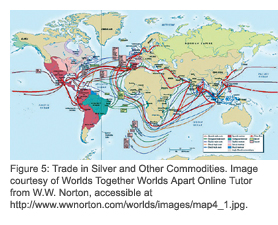
Regardless of the approach, it seems clear that the economic order that took shape after the European discovery of America redistributed unprecedented numbers of people to satisfy a growing global demand for its resources and products that in turn kept more labor and capital flowing in to the so-called new world. Overseas trade has been identified as the leading sector in economic growth during this period. Even in well established European nations, growth depended primarily on the expansion of the overseas trade sector (16). A major impetus for the adoption of the U.S. Constitution was the belief that survival as a nation depended on overseas commerce and that its success required a strong central government. [See Figure 5 for a map that identifies some of the major global trade routes of the eighteenth century.]
If the origins of world economic growth are linked to this global commerce, other forms of growth that have been associated with the discovery of America appear to be more problematic. The sizeable Atlantic migration proved disastrous for the indigenous population, primarily because of its susceptibility to new diseases brought by invaders or simply merchants who did no more than trade from their sailing vessels anchored offshore (17). Despite the staggering losses of Indian life in the Americas, the demographic record suggests growth in global population from the time of discovery onward. At first, as Table 1 shows, the ascent was modest and, although the detail here is not sufficient to indicate it, population numbers are believed to have stalled in the seventeenth century. Over the course of the eighteenth century, however, world population is estimated to have jumped by 50 percent, the slope slanting upward ever more steeply thereafter and continuing its dramatic ascent through the twentieth century.
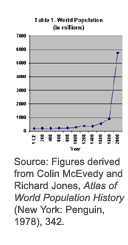
In the Americas, succeeding generations of Atlantic migrants and their descendants enjoyed high fertility rates in their new low density environment. Concurrently, Europe's population, despite the out-migration, began to climb, as did China's. Some of this "old world" growth has been attributed to the transfer of "new world" foodstuffs such as potatoes, sweet potatoes, peanuts, and corn (maize) as well as American sales of wheat and rice in European markets (18). While in North America the bounty in foodstuffs and the accompanying high fertility never produced a Malthusian reaction, in certain parts of nineteenth-century Europe and in China it eventually did. The denser population put greater pressure on natural resources. The environmental repercussions of the human species spreading into previously uninhabited parts of the globe is a fascinating subject that deserves a great deal more attention. Nowhere might the investigation be more worthwhile than in America during the period under consideration here.
Endnotes
1. The April 2004 issue [volume 18 no. 3] of the OAH Magazine of History, entitled "The Atlantic World" and edited by Alison Games, takes this approach and focuses on three themes in the Atlantic: disease, commodities, and migration. The issue contains references to the many books and articles that have been written on early modern Atlantic communities in the past two decades.
2. James Horn and Philip D. Morgan, "Settlers and Slaves: European and African Migrations to Early Modern British America," Elizabeth Mancke and Carole Shammas, eds., Creation of the British Atlantic World (Baltimore: Johns Hopkins University Press, forthcoming).
3. John Thornton, Africa and Africans in the Making of the Atlantic World, 1400-1800, 2nd ed.(New York: Cambridge University Press, 1998).
4. Immanuel Wallerstein, The Modern World System: Capitalist Agriculture and the Origins of the European World-Economy in the Sixteenth Century (New York: Academic Press, 1974), 41-42.
5. Victor Enthoven, "An Assessment of Dutch Transatlantic Commerce, 1585-1817," Riches from Atlantic Commerce: Dutch Transatlantic Trade and Shipping, 1585-1817, edited by Johannes Postma and Victor Enthoven (Leiden: Brill, 2003), 438; Nuala Zahedieh, "Overseas Expansion and Trade in the Seventeenth Century," in Nicholas Canny, ed., Oxford History of the British Empire: Origins of Empire (Oxford: Oxford University Press, 1998), 410.
6. Carole Shammas, The Preindustrial Consumer in England and America (Oxford: Clarendon Press of Oxford University Press, 1990).
7. Philip D. Curtin, The Rise and Fall of the Plantation Complex: Essays in Atlantic History (New York: Cambridge University Press, revised ed. 1998). Sidney Mintz recounts this process in Sweetness and Power: The Place of Sugar in Modern History (New York: Viking Press, 1985).
8. T. H. Breen, The Marketplace of Revolution: How Consumer Politics Shaped American Independence (New York: Oxford University Press, 2004).
9. Economic liberalism is used here in its nineteenth-century sense of belief in market forces of demand and supply rather than governmental policies directing production and consumption.
10. The later twentieth century witnessed a significant geographic shift of world trade towards the Pacific Rim.
11. Peter A. Coclanis, "Drang Nach Osten: Bernard Bailyn, the World-Island, and the Idea of Atlantic History," Journal of World History 13 (2002): 169-182.
12. Dennis O. Flynn and Arturo Giraldez, "Cycles of Silver: Global Economic Unity through the Mid-Eighteenth Century," Journal of World History 13 (2002): 391-428, and Enthoven, "An Assessment of Dutch Transatlantic commerce," 435-6 refer to the Dutch use of American silver for East Indies trade.
13. John E. Wills, Jr., "European Consumption and Asian Production in the Seventeenth and Eighteenth Centuries," in John Brewer and Roy Porter eds. Consumption and the World of Goods (London: Routledge, 1993), 133-47.
14. David Igler, "Diseased Goods: Global Exchanges in the Eastern Pacific Basin, 1770-1850," American Historical Review 109 (2004): 693-719.
15. See the statistics in Louis Dermigny, La Chine et L'Occident: Le Commerce a Canton au XVIIIe Siecle 1719-1833 tome II (Paris: S.E.V.P.E.N., 1964), 521-528, 532, 539, 735, and 744 that show the scope of America's entry into the tea trade from the 1780s on and also its supplying of silver and cotton.
16. Robert C. Allen, "Progress and Poverty in Early Modern Europe," Economic History Review 56 (2003): 431; Kevin H. O'Rourke and Jeffrey G. Williamson, "After Columbus: Explaining Europe's Overseas Trade Boom, 1500-1800," Journal of Economic History 62 (2002): 417-62. The latter article asks a number of good questions about the reasons for the boom in trade but lacks the evidence to prove its central contention that transport costs did not decline over the three hundred year period.
17. Igler, "Diseased Goods."
18. Flynn and Giraldez, "Cycles of Silver," concerning the effects of the transfer of maize, sweet potatoes, and peanuts over the Pacific.
I would like to thank the OAH/AP referees, and my colleagues John E. Wills Jr., Ayse Rorlich, and Darryl Holter for their comments and assistance in writing this essay.
Bibliographical Note
Classic treatments of the emergence of global trade include J. H. Parry's beautifully succinct The Establishment of the European Hegemony 1415-1715: Trade and Exploration in the Age of the Renaissance (New York: Harper and Row, Torchbook ed., 1961), Immanuel Wallerstein's three comprehensive volumes on the modern world-system, The Modern World-System: Capitalist Agriculture and the Origins of the European World-Economy in the Sixteenth Century; The Modern World-System II: Mercantilism and the Consolidation of the European World-Economy, 1600-1750; and The Modern World-System III, The Second Era of Great Expansion of the Capitalist World-Economy, 1730-1840s (New York: Academic Press, 1974-1989), and Fernand Braudel's magisterial Civilization and Capitalism III: The Perspective of the World, tr. Sian Reynolds (Berkeley: University of California Press, 1992, orig. pub. in French 1979).
The OAH Magazine of History 18 (April 2004) issue edited by Alison Games is an excellent guide to the ever-growing literature on the Atlantic World approach particularly as it relates to the area that became the United States. The Atlantic Seminar at Harvard University maintains a web site, http://www.fas.harvard.edu/~histecon/visualizing/atlantic-history/, that features recent research in the field and has links to other sites of interest. In addition to the Thornton book on the African Atlantic cited above, the existing ship manifests recording the African migration across the Atlantic are now available for study on CD, David Eltis et al. The Transatlantic Slave Trade: A Database on CD-Rom (New York: Cambridge University Press, 1999). The most exhaustive examination of transatlantic commerce is for Spain in the sixteenth and seventeenth centuries, Huguette Chaunu and Pierre Chaunu, Seville et l'Atlantique (1504-1640) 8 vols. (Paris: Colin, 1955-1959). The phenomenonal rise in consumer demand for groceries and the growth of the plantation complex is documented in Curtin, Mintz, Enthoven, Zahedieh, and Shammas mentioned above. For those seeking a regional breakdown of Anglo-American trade, see John J. McCusker and Russell R. Menard, The Economy of British America 1607-1789 (Chapel Hill: University of North Carolina Press, 2nd ed. 1991). Breen's book, above, relates the American Revolution to the Atlantic trade boom.
The need to take a global rather than an Atlantic world perspective, as expressed in Coclanis' essay cited above, comes largely from studying the work on monetary flows, Asian commerce, and the Pacific Rim. Dennis O. Flynn, in the article he co-authored above and in a series of other books and articles, has made the strongest case that the demand for silver in China created an integrated global economy both Atlantic and Pacific. In addition to the works on Chinese commerce and products by Dermigny and Wills cited above, a number of volumes have recently appeared confirming the size, allure, and sophistication of Chinese, Indian, and southeast Asian production during the period 1500 to 1800. Coclanis' essay cites many of them. Kenneth Pomeranz and Steven Topik, The World that Trade Created: Society, Culture, and the World Economy: 1400 to the Present (Armonk, NY: M.E. Sharpe, 1999) is designed for a general audience that picks up on that theme among others.
Colin McEvedy and Richard Jones, Atlas of World Population History (New York: Penguin, 1978) remains the best source for world population figures. The USC-Huntington Library Institute for Early Modern Studies has a new web site https://dornsife.usc.edu/emsi which offers online bibliographies with a world perspective on specific topics. Finally, https://networks.h-net.org/ is the web address for H-Net which features numerous networks for different fields in history, among them h-world and h-atlantic. These networks offer teaching resources, discussions, and reviews.
Carole Shammas holds the John R. Hubbard Chair in History at the University of Southern California. Her most recent book is A History of Household Government in America (2002).
Authored by
Carole Shammas
University of Southern California
Los Angeles, California