Jump to page content Jump to navigation

College Board

AP Central

AP Exam Reader
Siemens Awards for Advanced Placement

APAC 2010
Print Page
Home > AP Courses and Exams > Course Home Pages > Field Trips as a Means in Developing Concentrations

Field Trips as a Means in Developing Concentrations

by Barbara Sunday

Rationale-

As the AP Studio Art Poster indicates, the Portfolio for both 2-D Design and Drawing Portfolios requires a Concentration study in which students identify a visual problem, plan a strategy of investigation, develop a body of evolving works, and reflect upon the sequence in a written statement. The poster suggests that students should devote considerable time, effort, and thought to an investigation of a specific visual idea. Definition of the idea along with evidence of growth and discovery are key to success.

Mentoring students to accomplish this portion of the portfolio requirement can be a daunting task. The very idea of teenagers and concentration can seem to be opposite commodities. Getting long periods of sustained time to achieve the necessary amount of quality individual focus seems to be at the heart of the issue. In moments of sheer exasperation filled with the usual high school interruptions, it is often thought that if we could legally sequester students until the work is accomplished we might get somewhere.

Taking students away on a field trip to an unfamiliar environment has proven to be a solution to this dilemma. Removing students from their familiar surroundings increases their powers of observation and visual curiosity. Students can use the field trip as an opportunity to initiate a series of related images, finding and developing personal responses stimulated by a change of place.
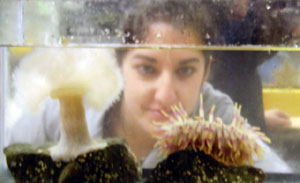
Student observing sea anemones
We might anticipate cries of "But I want to do my own ideas." "Own" ideas will shine through the new images. The very process of discovery through a changed viewpoint is key to the success not only of the field trip endeavor but also to the progression of pieces submitted in the Concentration Section.


Place-

Students need to be led to a place where they can be expressive in developing new imagery. This can be wherever the financial and logistical situation can bear: neighborhood back alleys, a rural village, a farm, or waterfront setting. Many students have opinions and a need to be expressive about the environment, and it seems there are lots of organized nature/ecology institutions providing wilderness experiences, environment demonstration areas, nature camps, outdoor schools, forestry conserves, and sustainability experiments which cater to school groups. These experiences. are a good match. Science programs can be adapted more easily than one might think to become studio art adventures. Images produced soon lead to some individual reactions in students that they wish to express as the series of pieces evolves.

The place can also be a tour. This limits the size of work that can be accomplished during the trip and also restricts the amount of material that can reasonably be carried along. However, students are more or less forced to be highly inventive. If the excursion takes students to parts of the world rich in architectural heritage, students may be interested in recording observations such as entranceways, architecture, and shelters - perhaps developing images that make increasing degrees of social comment as the body of work develops. Others may be curious about people, services, and signs that are unfamiliar. These provide excellent starting points that could lead to Juxtaposition of Images, or Visual Opposites as a theme of the Concentration. Further development might provide glimpses of behind the scenes observations contrasted with "tourist views".
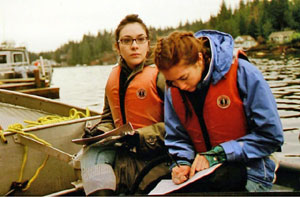
Students record a boating journey


Timing-

Ideally, an art field trip needs to occur late enough in the AP progress that students have acquired some skills along with a sense of serious and urgent need for focus but early enough to allow them the necessary time to develop images from field notes and reflect on sketches to complete final works. Other immediate concerns include time sensitive local regulations for traveling with youngsters, weather, as well as tour and site availability. A four-day excursion with new work introduced three times a day will allow students to initiate a range of work while taking field notes that can be used for finishing pieces back at school. A 10-day to 2-week trip over a spring break is excellent for the accomplishment of more developed pieces.

Program-

Certainly the idea of a field trip is not to replicate the school art program but rather to offer a wealth of new visual material. For some students the focus time and the excursion alone are enough to motivate a body of work. Downtime provides an excellent opportunity to discuss the nature of the concentration with individuals and linking the idea to the body of concentrated work. Others may need various degrees of mentoring to offer support for getting started. Two strategies outlined below have proven successful.


Strategy #1 - Getting There and Back

Goal:
To create a personal response to the "Journey" in a Sketchbook/Artists' Journal

Method:
In a sketchbook, and as the trip initiates, students are asked to record a series of observations. Images may at first seem rather chaotic and unrelated. A second stage involves the creation of relationships or finding a sense of order by looking for things that seem to add up to make some kind of visual sense when juxtaposed. By working into findings a sort of subconscious level is accessed that honors the randomness of the original observation and adds depth to the image.

Early decisions are made by chance with no knowledge of what might happen next. Students are asked to work from chaos to order and look for things to add up, to make sense of, and begin to be about something. Students are asked to bring one image into another, blend edges, and layers. Sequences develop while several pages are "on the go "at once. The elements of risk, change, and chance keep students "edgy" and alert for meaning.

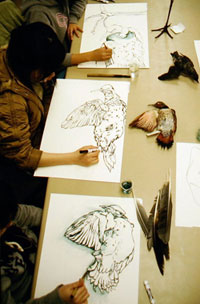
Drawing on location at the natural
history museum
The use of text, over printing, and collage can be of great benefit here. A sense of investigation or an eye for the unusual may become gateways, back alleys, or photo challenges. By framing a gum wrapper or postage stamp paired with the wording of an unusual road sign may become catalyst for further development. Contrast is essential so that each component in a composition shows.

Developing increasingly deeper levels of meaning by connecting a body of personal images becomes the Concentration. The journey itself becomes the subject. The trip becomes the journey to borrow a phrase from the late Dan Eldon, and threads of time, place, and circumstance become the focus of the Concentration.

Essential student packing -
  • Sketchbook with some pre-textured pages, attention to surface
  • Maps of location glued in, typical historical information ,and tourist information brochures, photo copied material
  • Supplies in sandwich-sized baggy: watercolor brush, permanent fineliner (dark), one caran d'ache neocolor 11 crayon for creating earth tone wash, 4B or 6B pencil with hand-held sharpener, tiny sized glue stick, eraser, a black crayola marker for blue wash, black ball point pen.
  • Tiny scissors in checked bag.
  • Camera
  • Collect along the way what is legal to collect
  • Individually packaged salt from restaurants for wash effect or caffeinated drink cups and dregs provide brown wash
  • Ticket stubs, wrappers, boarding pass, postage stamps for collage
    Artists: Nick Bantock - correspondences as an investigative model interact with questions and mystery - postage stamp ideas
    Understanding of what it means to work in layers
    • Larry Rivers, Rauschenburg
    • Dan Eldon Journals
  • See web site -
    Photographic Journals - The Journey Is the Destination Chronicle Books
    San Francisco, 1997
    www.chronbooks.com
    ISBN 0-8118-1586-2


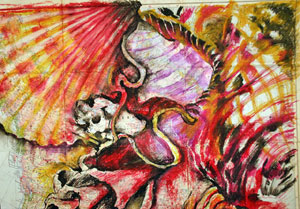
Field trip-inspired student artwork


Strategy #2 - Suitable for working out of one location Developing a series of experiences based the resources of one location requires knowledge of the resources of the place and knowledge of the unique resources available on site is essential to planning these studios. A pre-visit or reliable contact is necessary. A series of actual studio experiences can be introduced on-site and students are able to initiate a number of pieces while focusing on a theme. A series of workshops is planned to fit with the unique resources of the local site and pair with suitable media effective integration of concept and technique. These might be seaweed or leaf forms with watercolor, mammal skeletons using charcoal, or a forest walk with pencil and waterproof paper. Students are asked to take part in each presentation. Students are to combine the new image using materials provided with their Concentration focus.


Barbara Sunday has led many AP Art excursions. Successful arrangements have been made through the following: -EF Tours include Arthur's England, Spanish Fiesta, Charting the Galápagos. Itineraries were modified to include long spells of sketchbook and collage time. - Local destinations used repeatedly include Paradise Valley, a demonstration farm/eagle preserve near Whistler, BC, managed by North Vancouver School District Outdoor School, and Bamfield Marine Sciences Centre, Public Education Division, managed by 5 universities for marine research purposes at Bamfield, BC.
  ABOUT MY AP CENTRAL
    Course and Email Newsletter Preferences
  AP COURSES AND EXAMS
    Course Home Pages
    Course Descriptions
    The Course Audit
    Sample Syllabi
    Teachers' Resources
    Exam Calendar and Fees
    Exam Questions
    FAQs
  PRE-AP
    Teachers' Corner
    Workshops
  AP COMMUNITY
    About Electronic Discussion Groups
    Become an AP Exam Reader

Back to top