Reading Images: An Approach and a Demonstration
Approaching Images
Students need to learn how to read images, including images linked with texts, for many of the same reasons they learn how to analyze and interpret purely textual works of nonfiction and literature. Most of the general strategies used for interpreting and analyzing written texts can be imported to the analysis and interpretation of images. However, some of the particular techniques for analyzing and understanding images differ. Let’s dive right in by looking at the following image—really a pair of related images.
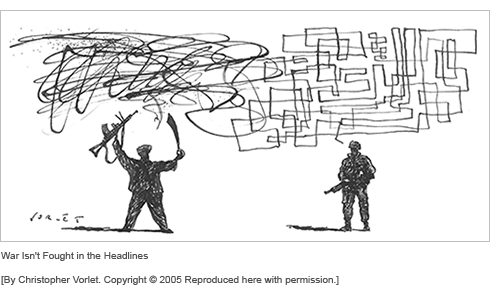
What do we notice when we view this image overall? What particular details stand out? What questions might we ask ourselves about those details?
As with the analysis of anything, we begin with observation—what we notice. Quickly scanning the overall image helps us to place it as a particular kind of image: we gain a sense of its genre. Most often we do this unconsciously, and we base our sense of genre on our prior experience with texts and images. There is much more to say about the importance of observation, and we will take the time to walk through a series of observations about this image. But the first thing we must do is identify its genre.
The image does not stand alone: it’s accompanied by a title. And while the visual image dominates the text both literally and figuratively, we will need to pay attention to that text once we have analyzed the visual elements. However, the words help us identify the genre of what we are looking at.
So how do we categorize this image with text? Is it a political cartoon? It appeared in the New York Times. If we are given its placement in the paper, as we are here, we determine that it is an illustration to accompany an op-ed piece, though we are only provided with the title of that piece here.
Now that we have established what we are looking at we are in a position to begin a more extended analysis, using four simple steps:
- Make observations.
- Connect the observations.
- Draw inferences from the related observations.
- Formulate a tentative interpretive conclusion.
Although we can proceed through these elements as steps or stages, they are not strictly linear. Instead, we move back through earlier steps more than once and anticipate inferences and conclusions even before completing our observations and connections.
Making Observations
Observations require focus. In looking carefully at each element of the overall image we see two silhouettes of figures (can we call them soldiers?), each holding a weapon. One of them, in fact, brandishes two weapons. We notice, too, that the figures’ postures differ, and that the way they wield their weapons differs as well. So do their uniforms, along with their relative sizes and the sizes of the shadows they cast.
What are we to make of these observations? How can we link or relate them? Shall we assume that the figures are adversaries, that they are in the same picture plane and field of space — that they stare directly at each other? Or do we see them as not directly confronting one another but rather as enemies who could and probably would do so in the normal structure of their experience? Of course, we must ask where these figures (soldiers) are meant to be located. Afghanistan, perhaps, or more likely Iraq, based on the date the article and image appeared in the Times.
But let’s look more closely at their weapons, which we noticed are differently held. Does the downward-pointing weapon of the soldier on the right suggest a peaceful stance? Or is this soldier ready to raise his weapon, readying it to shoot an enemy like the one pictured on the left? Why does this figure have his weapons raised aloft? In anticipation? In attack, defense, defiance, or celebration? Are we satisfied with describing those weapons as a gun and a sword? Or shall we pick up on the more precise rendering the artist provides, seeing them as a Kalashnikov and a scimitar? What connotations adhere to those terms and to the weapons those words denote?
We also notice that the artist has drawn a set of lines above each soldier. Once again, we notice differences in the crisscrossed lines above the soldier on the right and the darker, scribbled lines above the soldier on the left. The artist has actually used one aspect of the “bubble” convention to illustrate a figure’s thought or speech, in this case a short line just above each figure’s head to indicate that the lines above represent his words or his thoughts.
Making Connections
We have already begun making connections, as we have noted a series of contrasts between the two figures, their weapons, and the lines that appear above their heads. But we need to ask some questions about the relationship of these and other contrasting elements. We will also want to relate all the elements that accompany each figure’s image to one another and then relate the gestalt of each figure to the gestalt of the other.
Beyond these connections based on our detailed observations, we may wish to make other connections, such as those between this image overall and other images of soldiers we have seen. We may want to link this op-ed piece with other op-ed pieces we have viewed and read. And depending on how we eventually interpret the piece overall, we will connect it with other images and texts about war that we have seen and read, including recent military developments that pit figures like these against one another. But before doing any of those things, we need to have a brief look at the caption that appears beneath the figures.
It reads: “War Isn’t Fought in the Headlines.” What do we make of this statement? We can begin by noting that it’s in negative form, which leads us to ask the question: If war is not fought in the headlines, where is it fought? And even before we attempt to answer that, we should note that we need to link this headline to the details about the figures we have been describing. We begin a connection between words and images, even though we may not yet fully understand the piece overall.
Drawing Inferences
An inference is an educated guess, one that is grounded in careful observation and informed by thoughtful questioning—the kind of questioning we have been doing as we make connections among our observations. We know a good deal about the image because we have taken time to observe each of its elements. And we have asked a number of questions about the details of the image, including its relationship to the underlying caption.
What might we infer from what we have noted and queried so far? We might infer, for example, that the two soldiers are indeed foes, one an American soldier (or even an ally soldier) and the other an Iraqi insurgent (or perhaps a foreign mercenary insurgent). We might infer that the figure on the left is about to attack the one on the right, or we might infer that he is defending himself from the other figure, who is a trespassing invader of his homeland.
About the drawings above each figure we might infer that they represent radically different kinds of language and thinking. This inference could lead to another: that these adversaries not only do not understand each other or think like each other but that they speak mutually incomprehensible languages, possess diametrically opposed values, and have radically different understandings of the world.
About the caption beneath the figures we might infer that war is fought, on the one hand, on the ground of a particular country and, on the other, in the heads of the enemy combatants. This last possibility is suggested by considering the last word of the caption, “headlines.” If we break that word into its component parts “head” and “lines,” we get a literal rendering of what is pictured above the figures: lines that reflect what is going on in the head of each. The more diagrammatic lines above the American soldier could reflect an orderly, logical, analytical mode of thinking and operating. The less-patterned, less-orderly lines above the head of the insurgent could reflect a more emotional and chaotic kind of thinking and acting. But now we are pushing these inferences toward an interpretation.
Formulating a Conclusion
Arriving at an interpretive conclusion about such a rich piece isn’t easy. But our conclusion, remember, does not have to be final; it can remain tentative and provisional—and probably should. So how might we formulate a conclusion about this piece?
We might conclude that it suggests the mutual incomprehension at the heart of the cultures and worldviews of the figures depicted: their minds, like the worlds they inhabit, are dramatically different. And we might thus conclude that there does not appear to be much hope for dialogue between them, that any kind of real understanding is impossible. Christopher Vorlet’s drawing, with its accompanying caption, suggests that wars are fought by those whose languages, ways of thinking, values, and conceptions of right and wrong differ so dramatically that the conflict between them has little likelihood of ever really being resolved.
Further Thoughts and Suggestions
The approach to reading images (with text) that I have outlined here can be used to analyze any visual/textual combination. In analyzing an advertisement, for example, readers would follow the process by attending first to the images, then to the words, and then to the connections between words and images.
In analyzing the ad’s image, viewers would identify the major element and any minor elements, viewing larger pictures in relation to smaller ones, considering foreground in relation to background, etc. A logo or other icon as part of the picture would warrant attention as well.
Analogously, in analyzing an ad’s words, readers would consider the headline, the body copy, and the concluding clincher. Readers would break down the body copy into smaller chunks, paragraphs or sentences perhaps, depending on its length. They would analyze the ad’s language for tone and implication, attending to denotation and connotation, as well as to simile, metaphor, syntax, structure, wordplay, and sound—all the usual verbal suspects.
Teachers need to work with students to analyze advertisements and political cartoons and commentary, using the same tools of analysis they use to help students understand fiction, poetry, drama, and nonfiction. Approaches to analysis like the one outlined here, and others that accomplish the same goals—such as SOAPStone, which highlights a work’s subject, occasion, audience, purpose, style, and tone—are made to order for ads and political cartoons. So, too, are some of the formal approaches to rhetorical analysis that invite consideration of a work’s appeals (especially useful for advertisements), identification of its claims, and analysis of the evidence used to support those claims. Use of the rhetorical trinity of ethos, pathos, and logos is another such tool. But regardless of the tools used, students need opportunities to practice doing their own analysis, rather than just reading, hearing, or viewing someone else’s demonstration.
In working with the demonstration presented here, for example, it would be useful to provide students with the picture first without the words, as a way of focusing their attention on the visual. Perhaps the piece could be presented in sections, leaving off the lines above the heads of the figures, to encourage a close look at the figures and their weapons. This could then be followed by a fuller image with the lines included. Then after a thorough set of observations, connections, inferences, and a provisional conclusion, the caption could be introduced.
This kind of focused analysis not only allows for a more scrupulous consideration of image and text independently, but also provides for the gradual development of a reader/viewer’s understanding. Its goal is to slow down the analytical process, making it more deliberate (and deliberative) and providing a student with time to build an interpretation while laying a foundation beneath it. An added bonus is that students will be doing a good deal of critical thinking (though probably without being aware of it), employing strategies that can be taught, practiced, and learned.
Authored by
Robert DiYanni
New York, New York